Home
>
OCR
>
Best Amazon Textract Alternatives 2026: Top Tools Compared
Home
>
OCR
>
Best Amazon Textract Alternatives 2026: Top Tools Compared
Best Amazon Textract Alternatives 2026: Top Tools Compared
Businesses in 2026 are experiencing what many teams call "AWS fatigue." While Amazon Textract remains a well-known OCR and document extraction service, many companies are looking beyond AWS because of complex pricing, cloud-only processing, integration challenges, and growing demands for AI-powered document workflows.
As a result, organizations now actively compare Amazon Textract alternatives that offer better flexibility, easier deployment, improved handwriting recognition, and more predictable costs. This guide explores the best Amazon Textract alternatives available in 2026 and helps you select the right solution for your specific needs.

Part 1. Why Search for Amazon Textract Alternatives in 2026?
Amazon Textract remains a capable OCR and document processing platform, but many businesses have started evaluating competing solutions. Several factors drive this shift.
Key Reasons Businesses Explore Amazon Textract Alternatives
- High and unpredictable costs: Processing thousands of pages monthly — especially forms and tables — can make Amazon Textract pricing difficult to budget at scale.
- Accuracy gaps with complex documents: Handwritten forms, medical notes, poorly scanned PDFs, and mixed-language files often yield reduced accuracy compared to specialized OCR providers.
- AWS ecosystem dependency: Textract works best within AWS infrastructure, creating integration friction for teams using Azure, Google Cloud, on-premise systems, or hybrid environments.
Organizations facing any of these challenges frequently compare Amazon Textract alternatives before expanding their OCR operations.
Part 2. Best Amazon Textract Alternatives in 2026: Quick Overview
The OCR market offers solutions for every budget and business size. The following guide helps narrow down your choices quickly.
1. Enterprise-Level AI & Cloud APIs (The Heavyweights)
 Please swipe to view
2. Professional OCR Software (The Best ROI & Flexibility)
Please swipe to view
3. Open-Source & Community Solutions (The No-Budget Choice)
Please swipe to view
Part 3. Amazon Textract Alternatives: Open Source and Free Options
Businesses searching for Amazon Textract alternatives open source often want lower costs, greater control over their data, and the ability to run OCR locally. While these tools may require more technical setup than commercial OCR platforms, they remain some of the most popular Amazon Textract alternatives free options available today.
1. Tesseract OCR
Tesseract is one of the most established open-source OCR engines available today. Originally developed by Hewlett-Packard and later maintained by Google, it has become the standard OCR engine behind many document-processing applications. Tesseract supports more than 100 languages and uses LSTM-based neural networks to improve text recognition accuracy. Because it runs locally, organizations can process documents without uploading sensitive files to cloud services.

Key Features
- Supports 100+ languages
- Open-source and completely free
- Local and offline processing
- Works with PNG, JPEG, TIFF, and PDF workflows
- Supports custom model training
- Integrates with Python through PyTesseract and other wrappers
Limitations
- Requires technical setup and configuration
- Limited user interface for non-technical users
- Accuracy may drop on poor-quality scans and handwriting
- Requires additional tools for workflow automation and document management

Developers consistently praise Tesseract for its flexibility, extensive language support, and zero licensing costs. Many users consider it the benchmark for open-source OCR. However, business users often mention that setup and optimization require technical expertise, especially when compared to commercial OCR platforms that work immediately after installation.

Tesseract is best for developers, researchers, startups, and organizations seeking Amazon Textract alternatives open source with maximum customization and full control over document processing.

2. OCRmyPDF
OCRmyPDF is a specialized open-source tool designed specifically for scanned PDFs. Instead of acting as a general OCR engine, it adds a searchable text layer to existing PDF files while preserving the original document appearance. The software uses Tesseract as its OCR engine and includes additional features such as page rotation correction, deskewing, and PDF/A compliance for long-term archiving.

Key Features
- Converts scanned PDFs into searchable PDFs
- Preserves original document quality
- Supports PDF/A archival standards
- Automatic page rotation correction
- Deskew and image enhancement tools
- Batch processing support
- Multiple language support
Limitations
- Primarily focused on PDFs only
- Command-line interface may be challenging for beginners
- Limited AI-based document understanding
- Not designed for advanced invoice or form extraction
Users frequently highlight OCRmyPDF's reliability for digitizing archives and document repositories. IT teams and librarians particularly appreciate its ability to automate large-scale PDF processing while maintaining document integrity. Some reviewers note that its command-line approach creates a learning curve for non-technical users.
OCRmyPDF is best for document archiving projects, legal records management, government digitization initiatives, and organizations looking for Amazon Textract alternatives free for searchable PDF creation.
3. EasyOCR
EasyOCR is a deep-learning OCR library built on PyTorch and developed by JaidedAI. Unlike traditional OCR engines, EasyOCR uses modern neural network models for text detection and recognition. The project supports more than 80 languages and works well with both document OCR and real-world images containing text. Its simple API has made it popular among AI developers and computer vision researchers.

Key Features
- Supports 80+ languages
- Deep learning-based OCR models
- Works with natural scene text and documents
- GPU acceleration support
- Simple Python integration
- Handles multilingual text recognition
- Suitable for computer vision projects
Limitations
- Requires Python knowledge
- Higher hardware requirements than Tesseract
- Slower processing on systems without GPU acceleration
- Less suitable for users who want a graphical interface
The developer community often praises EasyOCR for strong multilingual recognition and its ability to handle difficult text layouts. Many users report better performance than traditional OCR engines on complex images. However, some users note that GPU resources significantly improve performance, especially for large document workloads.
EasyOCR is best for AI developers, machine learning engineers, multilingual OCR projects, and organizations seeking modern Amazon Textract alternatives open source that use deep learning technology.
Part 4. Amazon Textract Alternatives for Handwriting and PDF Extraction
When businesses compare Amazon Textract with other OCR solutions, handwriting recognition and PDF extraction usually become the deciding factors. Modern OCR platforms do much more than convert images into text. The following solutions are among the strongest choices in 2026 for handling scanned PDFs, forms, invoices, and handwritten documents.
1. PDNob PDF Editor
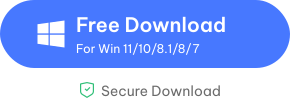
PDNob PDF Editor is an all-in-one PDF management solution designed for users who need OCR, PDF editing, document conversion, annotation, and AI-powered document assistance in a single desktop application. The software is especially useful for legal professionals, researchers, students, accountants, and office teams that want OCR functionality without APIs, coding, or complex cloud setups. In addition to text recognition, PDNob provides tools for editing, organizing, converting, and managing PDF documents efficiently.




- Advanced OCR Recognition: Converts scanned PDFs and image-based documents into searchable and editable text while supporting multiple languages and various document formats.
- Complete PDF Editing Tools: Allows users to edit text, images, links, page layouts, headers, footers, and other PDF elements without needing additional software.
- AI-Powered PDF Assistant: Includes AI features that can summarize documents, explain content, extract information, and help users work with lengthy PDFs more efficiently.
- Document Conversion and Export: Converts PDFs into Word, Excel, PowerPoint, TXT, Image, and other popular formats while preserving document formatting.
- Local Processing for Better Privacy: Processes documents directly on the user's device, which helps reduce cloud-upload requirements for sensitive business files and contracts.
Pros
- Easy interface suitable for non-technical users
- No coding or API knowledge required
- OCR, editing, and conversion tools included
- Supports multiple languages
- Fixed pricing compared to usage-based OCR services
Cons
- Not built for enterprise-scale API automation
- Limited workflow integrations compared to large cloud platforms
Many users appreciate PDNob PDF Editor for combining OCR, PDF editing, and AI-assisted document tools in one application. Reviews frequently mention that the software is easy to learn, performs well on scanned PDFs, and eliminates the need for multiple PDF management tools.
Small businesses, legal firms, educators, researchers, office professionals, and organizations looking for a no-code OCR solution with built-in PDF editing and local document processing.
2. Google Cloud Vision
Google Cloud Vision is Google's cloud-based computer vision platform. While many people know it for image analysis, object detection, and image classification, it also includes advanced OCR capabilities. The platform supports printed text extraction, dense document recognition, and handwriting detection through its OCR APIs. Google continues to position Vision AI and Document AI as key document-processing services for organizations managing large document collections.

Key Features
- Handwriting recognition
- Dense document OCR
- Multi-language support
- Image and PDF text extraction
- Cloud API integration
- AI-powered document analysis
- Structured OCR output with page, paragraph, and word-level data
Pros
- Strong OCR quality
- Good handwriting recognition
- Highly scalable cloud infrastructure
- Extensive API documentation
- Supports large enterprise deployments
Cons
- Requires cloud connectivity
- Usage-based pricing can increase at scale
- May require developer resources for integration
- Advanced workflows often require additional Google services
Developers and enterprise users often praise Google Cloud Vision for accuracy and scalability. Community discussions frequently recommend the service for handwriting OCR and image-based document extraction projects.
Organizations comparing Amazon Textract vs Google Cloud Vision, developers building OCR applications, and enterprises processing large document volumes.
Azure Document Intelligence
Azure Document Intelligence, formerly known as Azure Form Recognizer, is Microsoft's document-processing platform that combines OCR with AI-driven document understanding. The service extracts text, identifies layouts, detects tables, recognizes forms, and analyzes structured business documents. Microsoft positions it as more than a traditional OCR engine because it can understand document structure and key-value relationships.

Key Features
- Printed and handwritten text recognition
- Invoice extraction
- Receipt processing
- Identity document analysis
- Table and layout detection
- Custom document models
- Enterprise-grade security and compliance controls
Pros
- Excellent form extraction
- Strong PDF analysis capabilities
- Deep Microsoft ecosystem integration
- Custom AI model support
- Enterprise-level scalability
Cons
- More complex setup than desktop OCR tools
- Requires Azure ecosystem knowledge
- Costs can increase with large-scale processing
Many enterprise users highlight Azure Document Intelligence's ability to extract structured information from invoices, forms, receipts, and complex PDFs. Organizations already using Microsoft services often find integration easier than competing cloud OCR platforms.
Large organizations evaluating AWS Textract vs Azure Document Intelligence, enterprises processing forms and invoices, and businesses already invested in Microsoft Azure.
Part 5. No-Code Amazon Textract Alternatives for Business Automation
Many businesses want document automation without developers or data science teams.
What Are No-Code OCR Alternatives for Business Automation?
No-code OCR alternatives for business automation allow users to extract, classify, and process documents through visual interfaces rather than programming.
Benefits include:
- Faster deployment
- Lower training requirements
- Reduced development costs
- Easier workflow management
1. Nanonets
Nanonets is an AI-powered document processing platform that focuses on automating data extraction from invoices, receipts, purchase orders, IDs, bank statements, claims, and other business documents. It is widely used by finance and operations teams that need to automate high-volume document workflows.

Key Features
- AI-powered OCR and document extraction
- Pre-trained invoice and receipt models
- Purchase order and accounts payable automation
- Automatic document classification
Pros
- Pre-trained models reduce setup time
- Handles invoices from different vendors without extensive template creation
- Supports end-to-end workflow automation
Cons
- Costs can increase as document volume grows
- Advanced workflow configuration may require initial training
- Some businesses may need model tuning for highly specialized documents
User feedback generally highlights Nanonets' ability to reduce manual data entry and automate invoice processing. Businesses report significant time savings when handling accounts payable workflows and financial documents.
Nanonets is best for finance teams, accounts payable departments, operations teams, and businesses processing large volumes of invoices, receipts, purchase orders, and financial documents. It works particularly well for organizations that want AI-driven automation without building custom OCR systems.
2. Docparser
Docparser is a cloud-based document parsing platform designed to extract structured data from PDFs, Word files, scanned documents, and images using configurable parsing rules. Rather than relying primarily on AI models, Docparser focuses on rule-based extraction through pattern matching, anchor keywords, zonal OCR, and custom parsing templates. This approach makes it highly effective for organizations that process documents with predictable layouts and recurring formats.

Key Features
- Rule-based document parsing
- Zonal OCR technology
- PDF, Word, and image document support
- Table and line-item extraction
- Batch document processing
Pros
- No coding required
- Strong performance on structured documents
- Flexible parsing rules
Cons
- Less effective for highly variable document layouts
- Parsing rules require setup and maintenance
- Document format changes may require rule updates
User reviews consistently praise Docparser for reducing manual data entry and automating repetitive document processing tasks. Many customers report substantial time savings after configuring parsing rules. Reviews also mention strong reliability and integration options.
Docparser is best for businesses handling structured documents such as invoices, shipping records, purchase orders, application forms, and operational paperwork with consistent layouts. It is particularly suitable for organizations that want rule-based automation without investing in custom AI model development.
Part 6. How to Choose the Right Amazon Textract Alternative Based on Your Use Case
Selecting the right OCR solution depends on your workflow, budget, and technical resources.
Comparison Table
Please swipe to view
Final Checklist Before Choosing
Before selecting a solution, answer these questions:
- How many documents do you process monthly?
- Do you need handwriting recognition?
- Do you require cloud or local processing?
- Is predictable pricing important?
- Do you have developers available?
- Will you process sensitive documents?
- Do you need AI-powered extraction or basic OCR?
Your answers will quickly narrow down the most suitable option.
Decision Framework
Choosing becomes easier when you focus on your primary need.

- Need a desktop-based OCR tool with PDF editing, no coding required? → PDNob
- Need invoice or receipt automation? → Nanonets
- Need searchable PDF archives? → OCRmyPDF
- Need structured form or document parsing? → Docparser

- Need a free, self-hosted OCR engine? → Tesseract
- Need enterprise-scale document intelligence on Azure? → Azure Document Intelligence
- Need cloud-based OCR within AWS ecosystem? → Amazon Textract
- Need high-accuracy handwriting recognition? → Google Cloud Vision
Conclusion
As the search for Amazon Textract alternatives continues to grow in 2026, businesses are looking for solutions that offer flexible deployment, predictable pricing, and reliable handwriting recognition.
While Amazon Textract works well for many use cases, tools like PDNob PDF Editor provide a more straightforward path. With its built‑in OCR, full PDF editing capabilities, and no‑cloud requirement, PDNob stands as one of the most practical Amazon Textract alternatives for teams that want document intelligence without unnecessary complexity.



- Make scanned PDFs searchable and editable with 99% OCR precision
- Batch convert PDFs to Word, Excel, PPT, images, PDF/A, Text, EPUB, etc., up to 30% faster
- Edit PDFs easily like Word, including text, images, watermarks, links, and backgrounds
- Annotate PDF with highlights, comments, shapes, stickers, and stamps
- Run smoothly on any PC without lags or crashes, even on low-spec machines
 Secure Download
Secure Download
Speak Your Mind
then write your review
Speak Your Mind
Leave a Comment
Create your review for PDNob articles
Related articles

Software Reviewer and Comparison Analyst
Maya Patel has reviewed over a hundred softwares across writing, design, productivity, and AI categories, and her comparison articles are designed to give readers a clear winner within the first three paragraphs in past 3 years.