Home
>
Alternative Tips
>
Is Adobe Acrobat Too Expensive? Pricing & Best Alternatives
Home
>
Alternative Tips
>
Is Adobe Acrobat Too Expensive? Pricing & Best Alternatives
Is Adobe Acrobat Too Expensive? Pricing & Best Alternatives
- 1 Adobe Acrobat feels expensive because of the subscription model, especially for casual users who do not need to edit PDFs every day.
- 2 Acrobat Pro is still the strongest option for heavy PDF workflows, including advanced OCR, business documents, and enterprise use cases.
- 3 Foxit offers better long-term value for SMB and mid-market teams, with lower total cost, built-in AI tools, and admin controls that Adobe does not match at the same price level.
- 4 PDNob is the most cost-effective one-time alternative for individuals and small teams, combining AI OCR, full editing, offline privacy, and Windows + Mac support.
- 5 The best choice depends on workflow, not brand name, because Adobe is worth paying for only when OCR accuracy, enterprise security, or ecosystem integration really matters.
Adobe Acrobat too expensive is mostly a subscription problem, not a value problem. For daily editors, legal and business users, and anyone who needs advanced OCR or security features, Adobe Acrobat can still be worth the price; for occasional users, it usually is not. This guide breaks down Adobe Acrobat’s 2026 pricing, what each plan actually includes, and which one-time-purchase alternatives can save you over $1,300 over five years.

Part 1. Why Does Adobe Acrobat Feel So Expensive? A 2026 Pricing Breakdown
Adobe Acrobat Pricing at a Glance
Adobe sells four tiers, and pricing varies only slightly by region or ongoing promotions.
 Please swipe to view

Acrobat Pro is the plan most professionals choose, since it's the entry point for OCR and advanced editing. For many users, it becomes the largest recurring software expense after Microsoft 365.
Subscription vs. One-Time Purchase: Which Costs More?
Subscriptions cost more over time, often by hundreds of dollars, because you keep paying the full fee whether you edit PDFs daily or twice a year.
Please swipe to view
Software with a lifetime license breaks this pattern: you pay once and keep using it without another annual renewal. The same math applies at every Adobe tier --- Standard runs about $989 and Studio about $1,499 over five years --- so moving to a higher plan only widens the gap. For occasional users, that difference can save hundreds of dollars over a few years --- which is why so many buyers now search for an Adobe Acrobat alternative one time purchase before renewing.
Does Every User Need Adobe Acrobat?
Do I need Adobe Acrobat? The short answer is: it depends. Adobe still leads the industry, but most everyday PDF tasks don't require its full enterprise toolset.
Ask yourself these questions:
- Do you edit PDFs every day?
- Do you work with legal or government documents?
- Do you need advanced OCR?
- Do you build complex PDF forms?
- Do you require enterprise-level security?
Answer "yes" to most of these, and Adobe Acrobat Pro 2026 is likely worth it. Answer "no," and another PDF editor can probably meet your needs at a fraction of the cost --- which is exactly why so many people ask is Adobe Acrobat worth it before subscribing.
If You Decide to Stick with Adobe: Which Plan Fits?
If you've weighed the trade-offs and still want Adobe, match the plan to your actual workload instead of defaulting to Pro. Acrobat Standard covers most solo editing, signing, and form-filling needs. Acrobat Pro is worth the extra $5/month only if you regularly OCR scanned documents or compare document versions. Acrobat Studio makes sense mainly for teams that will actually use the AI Assistant and PDF Spaces on a weekly basis --- otherwise you're paying $10/month more for tools that sit unused.
Part 2. Is Adobe Acrobat Worth It? Features and Use Cases Explained
For daily, professional PDF work, yes --- Acrobat remains the industry standard because of its reliability, frequent updates, and compatibility with nearly every PDF workflow. For light or occasional use, the value proposition is weaker, since much of what you pay for goes unused.

Core Features of Adobe Acrobat
Acrobat Pro's toolset covers nearly every PDF task:
- Edit text and images
- Convert PDFs to Word, Excel, and PowerPoint
- Merge and split PDF files
- OCR for scanned documents
- Create fillable forms
- Password protection and redaction
- Electronic signatures
- Compare document versions
- Organize and compress pages
- Cloud storage and file sharing
Why Adobe Is Still the Industry Standard
Adobe created the PDF format, so its software typically supports new PDF technologies before competitors do. Most businesses standardize their document workflows around Acrobat: employees already know the interface, IT teams support it, and clients expect Adobe-compatible files. Procurement teams also treat Acrobat as the default, lower-risk choice simply because of its two-decade track record with regulated industries. That said, being the standard doesn't make it the best fit for every budget --- someone editing a few PDFs a month may never use enough of Acrobat's tools to justify its price.
Who Actually Needs Adobe Acrobat?
Acrobat Pro 2026 is typically a good fit for legal professionals, accountants, government offices, corporate teams, engineers, architects, HR departments, universities, large businesses, and anyone processing hundreds of PDFs a month. For these users, daily use makes the subscription cost easy to justify.
Part 3. Is There a Less Expensive Alternative to Adobe? 3 Best Acrobat Alternatives
If Adobe Acrobat feels too expensive, you have real options. Several PDF editors now match its everyday editing, OCR, and annotation tools with an Adobe Acrobat alternative one time purchase. Business users running advanced workflows may still prefer Adobe; students, freelancers, and small businesses often save more by choosing an Adobe Acrobat alternative one time purchase.
1. PDNob PDF Editor
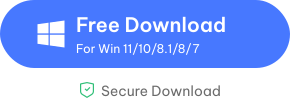
PDNob PDF Editor is a lightweight, affordable AI-powered PDF editor built for OCR and document workflows. For users who find Adobe Acrobat too expensive, it offers the core tools needed for editing, scanning, conversion, and AI-assisted productivity without the recurring price tag.





- One-time lifetime license removes recurring subscription payments and lowers long-term software costs.
- AI-powered OCR converts scanned PDFs into searchable, editable documents with minimal manual cleanup.
- Full PDF editing covers text, images, pages, annotations, forms, and signatures in one application.
- Fast file conversion supports Word, Excel, PowerPoint, and image formats while preserving layout.
- A straightforward interface keeps editing simple for beginners without limiting what professionals can do.
Price Model
-
Free trial available
-
Annual subscription available
-
Lifetime license: $64.99 (one-time payment)

What Actually Sets It Apart
PDNob's OCR reconstructs a searchable, editable PDF rather than just plain text you have to copy out, and unlike Foxit, there is no subscription tier at all — $64.99 buys the full toolset for good. Its AI features go beyond translation and summarization to include AI chat with the document itself, and the AI add-on costs $39.99 for a lifetime unlock of all AI-related features.
Pros:
- One-time payment covers the full app;
- AI OCR keeps formatting instead of dumping raw text;
- AI chat/summarization built in;
- runs natively on both Windows and Mac.
Cons:
- Smaller cloud ecosystem than Adobe;
- fewer enterprise collaboration tools;
- Best for: users who want an Adobe Acrobat alternative one time purchase, edit PDFs regularly, need OCR, or work as freelancers and in small businesses.
- Not ideal for: large enterprises running Adobe-based workflows or organizations that need Adobe-specific integrations.
On G2 and Capterra, users consistently describe PDNob as easy to learn, fast for everyday editing, and good value for the price --- though some note that Adobe still offers a larger ecosystem for enterprise use.
2. PDFgear
PDFgear is the only editor in this comparison that costs nothing at all right now --- full editing, conversion, and OCR with no watermark, no signup, and no feature paywall --- but "free" comes with real trade-offs in precision and depth.

Price Model: Free (developer has stated some AI/cloud features may become paid in the future; core desktop editing remains free today).
What Actually Sets It Apart
PDFgear's OCR extracts text from scanned PDFs in 30+ languages, but it only outputs plain copyable text or a .txt file --- it doesn't rebuild a formatted, editable PDF the way PDNob or Adobe do. Page and form tools cover the basics (insert, rotate, crop, fillable fields) but lack fine controls like text alignment, spacing, or auto form-field detection. There's also no cloud sync across devices, so it's a single-machine tool, not a team workflow.
Pros:
- Genuinely free with no watermark or usage cap right now;
- built-in AI copilot for summarizing documents;
- works on Windows, Mac, iOS, and web.
Cons:
- OCR output isn't reformatted into an editable PDF, only raw text;
- no cloud sync or device handoff;
- imited form-building and text-alignment controls;
- ong-term pricing model isn't guaranteed to stay free.
- Best for: users who edit PDFs occasionally, need a free solution, or are students and home users.
- Not ideal for: anyone who needs OCR output to stay in an editable PDF layout, or teams syncing files across devices.
Reviewers on G2 and Capterra consistently call out the free price and AI copilot as standout strengths, while flagging weak cloud sync and thinner form-building tools than Acrobat Pro 2026.
3. Foxit PDF Editor
Foxit PDF Editor is the closest like-for-like Adobe replacement --- same ribbon-style interface, similar OCR and editing depth --- at roughly 30-45% less per seat, plus a couple of workflow advantages Adobe doesn't have.

Price Model:
-
PDF Editor: £109.87/year (~$139/year)
-
PDF Editor+: £135.23/year (~$171/year)
-
A perpetual (one-time) license is also available by contacting Foxit sales, unlike Adobe, which no longer offers one at any tier.

What Actually Sets It Apart
Foxit supports full drag-and-drop text and image editing --- click, drag, drop anywhere on the page --- where Acrobat still requires more click-through steps to reposition content. Its AI Assistant is included free with a monthly credit allowance, while Adobe charges $4.99--$5/month extra for the same kind of feature. Foxit's mobile app also supports full inline editing, not just viewing and signing like Acrobat's mobile app.
Pros:
- Familiar Adobe-like interface cuts the learning curve to under a day for switchers;
- drag-and-drop editing Adobe lacks;
- AI Assistant included at no extra cost;
- Lighter and faster on large PDFs.
Cons:
- Interface still feels dense to first-time PDF users;
- the base "PDF Editor" tier doesn't include Editor+'s advanced OCR/redaction;
- a perpetual license isn't sold off-the-shelf and requires contacting sales.
- Best for: users who need professional PDF editing, want lower subscription costs, or work across Windows and Mac.
- Not ideal for: occasional PDF users or anyone wanting completely free software.
On Reddit, G2, and Capterra, reviewers describe Foxit as a capable Adobe replacement with similar editing tools, though some say Adobe still leads on enterprise compatibility.
Part 4. Adobe Acrobat VS PDNob: Which PDF Solution Should You Choose?
The choice comes down to your budget and how often you edit PDFs. Both tools cover core editing and OCR --- the real difference is pricing, not capability, for most everyday tasks.
Head-to-Head Comparison
Please swipe to view
The True Cost of Staying on Adobe vs. Switching
Please swipe to view
Switching from an Adobe Acrobat Pro subscription to PDNob's lifetime license saves approximately $1,379.40 − $64.99 = $1,314.41 over five years --- enough to cover other software or business expenses for freelancers, students, and small businesses. Put another way, PDNob's one-time fee pays for itself compared to Acrobat Pro in under three months, and every month after that is pure savings.
Decision Guide by User Type
Please swipe to view
If you're still asking do I need Adobe Acrobat, consider how often you'd actually use its advanced tools --- most individual users never touch them, making a lower-cost solution the smarter purchase.
Part 5. FAQs about Adobe Acrobat Too Expensive
Q1. Is Adobe Acrobat Pro 2026 worth buying?
A1: Yes, if you edit PDFs daily, work with legal documents, build forms, or need advanced OCR and security. For occasional users, the subscription often costs more than the value it delivers.
Q2. Can I save as a PDF without buying Adobe?
A2: Yes. Windows, macOS, Microsoft Office, Google Docs, and many free PDF editors all let you save documents as PDFs without an Adobe subscription.
Q3. What is the least expensive way to get Adobe Acrobat?
A3: Paying annually instead of monthly, or choosing Acrobat Standard instead of Pro if it covers your needs, is usually cheapest. Students and businesses may also qualify for discounts.
Q4. What are the benefits of one-time purchase PDF software?
A4: You avoid recurring payments, keep total ownership cost low, continue using the software after purchase, and skip annual renewal fees --- a good fit for anyone who edits PDFs regularly but doesn't need enterprise-level services.
Q5. Does Adobe offer a one-time purchase option instead of a
subscription?
A5: No. Adobe discontinued perpetual licenses years ago, and Acrobat Reader, Standard, Pro, and Studio are all sold on a recurring subscription basis today. Anyone who wants a true one-time payment needs to look at alternatives like PDNob PDF Editor, PDFgear, or Foxit instead.
Conclusion
Whether Adobe Acrobat too expensive is the right way to describe it depends on how you use PDF software. Adobe still leads in enterprise document management, advanced security, and professional workflows, and for businesses relying on those features daily, the subscription is easy to justify. But if your work is mostly editing, converting, OCR, and annotating PDFs, paying over $1,300 across five years may not make sense.
For an Adobe Acrobat alternative one time purchase, PDNob combines AI-powered OCR, full editing, and document conversion with a lifetime license at a fraction of the long-term cost.
Speak Your Mind
then write your review
Speak Your Mind
Leave a Comment
Create your review for PDNob articles
Related articles

Software Reviewer and Comparison Analyst
Maya Patel has reviewed over a hundred softwares across writing, design, productivity, and AI categories, and her comparison articles are designed to give readers a clear winner within the first three paragraphs in past 3 years.