Home
>
OCR
>
Top 7 PaddleOCR Alternatives 2026: Accuracy, Speed & Migration Guide
Home
>
OCR
>
Top 7 PaddleOCR Alternatives 2026: Accuracy, Speed & Migration Guide
Top 7 PaddleOCR Alternatives 2026: Accuracy, Speed & Migration Guide
PaddleOCR is a popular OCR tool that many developers use for text recognition. It supports multiple languages and works well for many tasks. However, it is not perfect for every situation. Some users face issues with setup, speed on CPU, or large model size. Because of this, many people now search for a PaddleOCR alternative that is easier, faster, or more lightweight.
In this guide, you will explore 7 strong alternatives with real comparisons, performance insights, and simple code examples to help you switch quickly and choose the best option for your needs.

Desktop PDF tool built on ABBYY OCR — edit documents, extract text from scans, convert formats at full resolution, with 7 days free trial.
 Secure Download
Secure Download
Part 1. PaddleOCR Review: Why Users are Looking for Alternatives
Before choosing any PaddleOCR alternative, you should understand how PaddleOCR works, what it does well, and where it falls short. This helps you make a better and more practical decision.
PaddleOCR Strengths: Why Developers Love It
PaddleOCR works well for many use cases. It supports many languages and gives good accuracy.
Here are its main strengths:
- Supports 80+ languages
- Works for printed and some handwritten text
- Good accuracy for structured documents
- Active open-source community
- Supports detection + recognition pipeline
Many developers compare PaddleOCR vs tesseract and find PaddleOCR better in complex layouts.
5 Critical Limitations of PaddleOCR
Even though it works well, users still look for a PaddleOCR alternative due to these issues:
- Heavy Model Size: PaddleOCR models can be large. This makes deployment harder on low devices.
- Complex Setup: Some users struggle with installation, especially GPU setup.
- Slower on CPU: If you do not use GPU, speed drops a lot.
- Limited Handwriting Accuracy: When people test trocr vs PaddleOCR, TrOCR often wins for handwriting.
- Memory Usage: It uses more RAM than tools like Tesseract.
Because of these issues, many developers search for the best PaddleOCR alternative.
Is PaddleOCR Safe? Security, Licensing & Privacy Unpacked
Many users ask: is PaddleOCR safe? Here is a simple answer:
- PaddleOCR is open-source (Apache 2.0 license)
- You can run it locally, so your data stays private
- No data is sent to external servers unless you do it
So yes, is PaddleOCR safe → generally yes for local use.
Still, always check:
- Third-party models
- Cloud integrations
- Data storage practices
Desktop-based PDF editor that keeps files on your device — edit, convert, OCR images with ABBYY SDK with 7 days free trial.
Secure Download
Secure Download
Part 2. PaddleOCR vs. Alternatives: Accuracy, Speed & Safety at a Glance
Before you pick a PaddleOCR alternative, you should compare accuracy, speed, and safety. These factors directly affect performance and user experience, so a clear side-by-side view helps you choose the right OCR tool for your needs.
Accuracy Showdown
Here is a simple comparison:
- PaddleOCR → strong overall accuracy
- Tesseract → weaker for complex layouts
- EasyOCR → good balance
- TrOCR → best for handwriting
- PDNob → all-in-one solution
Many developers compare easyocr vs PaddleOCR and find EasyOCR easier to use.
In trocr vs PaddleOCR, TrOCR gives better results for handwritten text.
Speed & Hardware: CPU vs GPU
- PaddleOCR → fast on GPU, slow on CPU
- Tesseract → fast on CPU
- EasyOCR → moderate speed
- TrOCR → needs GPU for best performance
- PDNob → highly optimized for CPU performance
If you run CPU-only systems, PaddleOCR vs tesseract shows Tesseract is lighter.
At-a-Glance Comparison Table
 Please swipe to view
This table helps you pick a PaddleOCR alternative quickly.
Part 3. Top 7 PaddleOCR Alternatives 2026: Free & Open Source Compared
Now let's explore the top PaddleOCR alternative tools available in 2026. These options offer different features, performance levels, and use cases, so you can choose the one that best matches your project needs.
1. Tesseract OCR - Most Established & Lightweight
Tesseract OCR is one of the oldest and most trusted open-source OCR engines. HP first built it, and Google later improved it. It supports over 100 languages and works on Windows, Linux, and macOS. Developers use it widely for simple OCR tasks because it runs well on CPU and needs very low resources. Many users compare PaddleOCR vs tesseract when they need a fast and lightweight solution for basic text extraction.


- Supports 100+ languages
- LSTM-based OCR engine
- Works offline
- Cross-platform support
Pros
- Very small size (~10MB)
- Fast on CPU
- Stable and reliable
Cons
- Weak layout detection
- Poor performance on handwriting
- Needs clean images
Real Users Review
Many users say Tesseract works best on clean scans but fails on complex layouts and noisy images.
Best for:
Simple OCR tasks and low-resource environments

2. EasyOCR - Developer-Friendly & Multi-Language
EasyOCR is a deep learning OCR library built for developers who want quick setup and strong results. It supports more than 80 languages and works with a simple Python API. Many developers prefer it because they can start using it with just a few lines of code. When people compare easyocr vs PaddleOCR, they often choose EasyOCR for easier setup and flexibility in real-world images like screenshots and photos.

- 80+ language support
- PyTorch-based model
- Simple API
- Works with GPU (optional)
Pros
- Easy installation
- Good for real-world images
- Flexible for developers
Cons
- Slower on large datasets
- Weak layout understanding
Real Users Review
Users say EasyOCR works well for mixed text and images but struggles with structured documents.
Best for:
Quick development and image-based OCR apps
3. PDNob PDF Editor - OCR + AI Tool
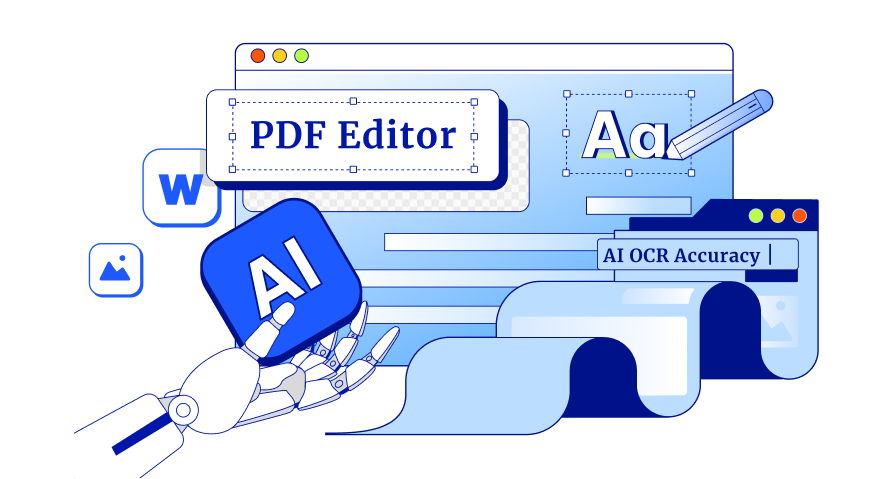
PDNob PDF Editor is not just an OCR tool. It combines OCR with PDF editing features, which makes it useful for business and document workflows. It can scan PDFs, convert them into editable text, and support AI-based recognition.
The 2.0 update combines high-precision scanning with professional editing, making it the top PaddleOCR alternative for those who need to convert complex PDFs without coding. With its faster 2.0 engine and intuitive interface, you get developer-level accuracy in a simple, business-ready package.

- AI-Powered OCR: Instantly convert scanned PDFs into editable text with PDNob 2.0's high-precision engine.
- Smart Recognition: Advanced AI identifies layouts, tables, and handwriting while maintaining original formatting.
- Pro Editing Suite: Modify text, images, and annotations directly on your device with 2.0 speed and privacy.
- High-Speed Batching: Process hundreds of documents simultaneously using the optimized multi-thread 2.0 system.




Pros
- Easy to use
- Good for office work
- Accurate PDF OCR
Cons
- Not fully open-source
- Limited for developers
Real Users Review
Users rave about the PDNob 2.0 experience, highlighting its seamless blend of a simple, intuitive UI with professional-grade accuracy. Professionals especially appreciate how the 2.0 update handles complex PDF layouts that other tools fail to recognize, consistently delivering flawless, editable results without the learning curve.
Best for:
PDF editing and document workflows
4. LayoutParser - Best for Layout Analysis & Tables
LayoutParser is an open-source toolkit built for document layout analysis. It focuses on detecting tables, text blocks, and structured content before OCR processing. It works well with deep learning models and integrates easily with other OCR tools.
Developers often use it alongside OCR engines to improve results on complex documents. If you struggle with tables and structured layouts in PaddleOCR alternative tools, LayoutParser gives better control and accuracy.

- Layout detection
- Table recognition
- Pre-trained models
- Integration with OCR tools
Pros
- Strong for structured documents
- Good table extraction
- Flexible pipeline
Cons
- Requires ML knowledge
- Not a full OCR engine
Real Users Review
Users say it improves OCR results when working with invoices and forms.
Best for:
Complex layouts and table extraction
5. TrOCR - Transformer-Based End-to-End OCR
TrOCR is a modern OCR model developed using transformer architecture. Microsoft introduced it as an end-to-end OCR solution that handles both detection and recognition in one model. It performs very well on handwritten text and complex documents. When developers compare trocr vs PaddleOCR, TrOCR often gives better results for handwriting tasks. However, it needs more computing power, especially GPU, for good performance.

- Transformer-based model
- End-to-end OCR
- Strong handwriting recognition
- Pretrained models available
Pros
- High accuracy
- Best for handwriting
- Modern AI approach
Cons
- Heavy model size
- Needs GPU
Real Users Review
Benchmarks show TrOCR performs well in accuracy but may be slower and resource-heavy.
Best for:
Handwritten text recognition
6. GLM-OCR - Lightweight Multimodal OCR (0.9B params)
GLM-OCR is a newer OCR model based on multimodal AI systems. It combines vision and language understanding, which helps it read text in more complex scenes. With around 0.9 billion parameters, it stays smaller than large vision models while still giving good performance. Developers exploring a modern PaddleOCR alternative often test GLM-OCR because it handles mixed content better than traditional OCR engines.

- Multimodal OCR
- Lightweight model
- Works with images and text
Pros
- Modern AI design
- Better context understanding
- Efficient compared to large models
Cons
- Still developing
- Limited community support
Real Users Review
Early users report better results than traditional OCR in mixed-content images.
Best for:
AI-based OCR and multimodal tasks
7. DocTR - Document Understanding Toolkit
DocTR (Document Text Recognition) is an open-source deep learning OCR toolkit built for full document understanding. It provides both text detection and recognition models. Developers use it for building AI pipelines that process documents like invoices and forms. In many benchmarks, DocTR shows strong accuracy and balanced performance. When comparing tools like easyocr vs PaddleOCR, DocTR stands out for structured document workflows and deep learning integration.

- Detection + recognition models
- Deep learning-based OCR
- Supports document pipelines
Pros
- Good accuracy
- Works for complex documents
- Flexible for AI workflows
Cons
- Needs ML knowledge
- Setup can be complex
Real Users Review
Benchmarks show DocTR provides strong accuracy with balanced speed.
Best for:
AI document processing systems
Part 4. How to Choose the Right PaddleOCR Alternative
Before selecting a PaddleOCR alternative, you need to understand your project needs, system resources, and accuracy requirements. This section helps you compare tools in a simple way so you can choose the right OCR solution without confusion.
Please swipe to view
Best PaddleOCR Alternative by Use Case
- Processing Standard Printed Text → Tesseract
- Rapid Prototyping & Multi-Language Needs → EasyOCR
- Converting Scanned PDFs with Layout Fidelity → PDNob
- Recognizing Handwritten Notes or Forms → TrOCR
- Building End-to-End Document Analysis Pipelines → DocTR
Choose based on your needs, not hype.
When You Should NOT Switch
Do not switch if:
- PaddleOCR already works well
- You need multi-language support
- You rely on its detection pipeline
Sometimes the best PaddleOCR alternative is no change at all.
Part 5. FAQs About PaddleOCR Alternatives
Q1. Which is better, EasyOCR or PaddleOCR?
A1: In easyocr vs PaddleOCR, EasyOCR is easier to install and use. PaddleOCR gives better accuracy for complex layouts and multi-column documents, so choice depends on your use case.
Q2. Is PaddleOCR Free to Use?
A2: Yes, PaddleOCR is free and open-source. If you ask is PaddleOCR safe, it is safe for local use because it runs offline without sending data to external servers.
Q3. TrOCR vs PaddleOCR - Which handles handwriting best?
A3: In trocr vs PaddleOCR, TrOCR performs better for handwritten text recognition. PaddleOCR works well for general text, but TrOCR gives higher accuracy on handwriting tasks.
Q4. Is there a lightweight alternative to PaddleOCR (under 200MB)?
A4: Yes, Tesseract is a very lightweight option under 200MB. In PaddleOCR vs tesseract, Tesseract is faster on CPU and works well for simple OCR tasks.
Conclusion
PaddleOCR is a robust general-purpose OCR tool, but it is not the optimal solution for every task. This is precisely why users seek a PaddleOCR alternative-to find a tool better suited for specific requirements. For workflows specifically involving the conversion of scanned PDFs with a focus on layout and format preservation, dedicated tools like PDNob are often a more suitable alternative.
The best choice ultimately depends on aligning the tool's strengths with your specific project requirements for accuracy, performance, and integration ease.
Speak Your Mind
then write your review
Speak Your Mind
Leave a Comment
Create your review for PDNob articles
Related articles

AI Tools Writer / Workflow Analyst
Rachel has spent the last 5 years testing and writing about AI-powered tools across writing, design, and research workflows. She focuses on practical AI tool usage, helping knowledge workers turn generative AI into everyday productivity.