

PDNob Online is currently available only on Windows and Mac desktop computers. Please switch to a desktop browser to use our features.
Founded in 2007, Tenorshare PDNob is trusted by millions to simplify work.
9,213,548 ID cards and identity documents have been processed with id card ocr.
Get PDNob Desktop, Your All-in-One PDF Solution!
Follow These 3 Steps to Read Identity Document Data:
If you're wondering how to scan id cards, just drag a photo, attach a PDF, or point your phone camera. The tool accepts JPG, JPEG, PNG, TIFF, and BMP.
Pick the recognition language, choose an output language, and click "OCR PDF" to start the recognition run.
Download the recognized fields as a searchable PDF, or copy the holder name, ID number, and date of birth straight into your form.
Holographic overlays, lamination, and reflective coatings scatter light in unpredictable ways, and a generic id scanner pic app tends to wash out the name or document number the moment the angle is off.
Each issuing authority prints ID cards with its own field order, font, language, and MRZ format, so a fixed-template scanner id pipeline has to be retrained the moment a new country or state appears.
Real-world users snap their ID with a phone in poor light, at an angle, with a thumb shadow over the corner. Pre-processing has to handle rotation, blur, and partial crops before any cards canner pipeline even starts.
One ID card can stack Latin, Cyrillic, Arabic, and CJK characters on the same face, and a single-language engine drops everything outside its training set, so script-aware recognition has to be baked in from the start.
PDNob's id card ocr software runs on the ABBYY recognition engine, the same engine that drives enterprise KYC platforms. Whether the source is a flatbed scan, a forwarded PDF, or a phone snap, the recognition layer pulls the holder name, ID number, date of birth, address, and expiry as separate editable fields, ready to drop straight into Excel, your CRM, or your KYC pipeline. After the run, the scan id card online free output is gone from the server within minutes.
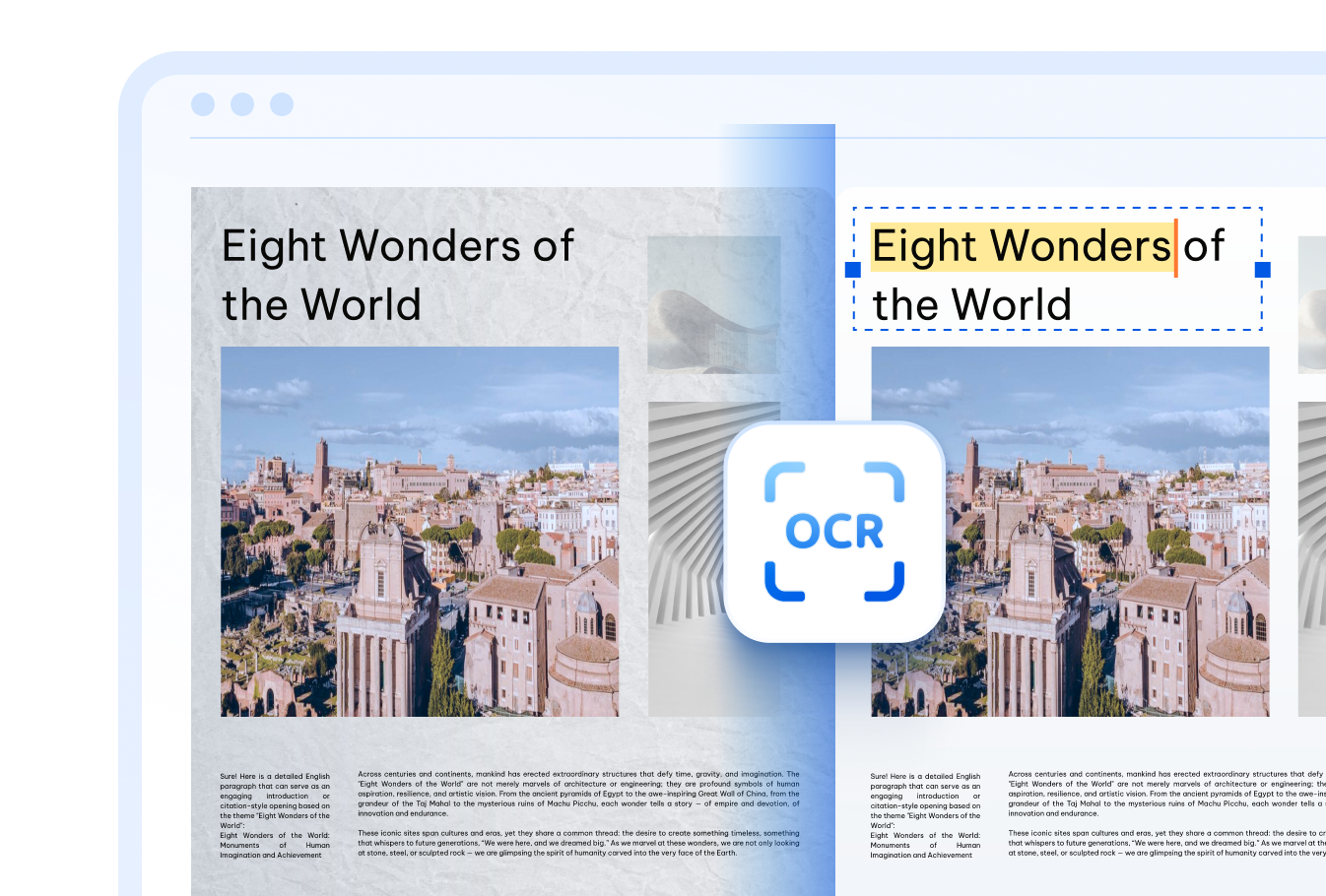
After recognition finishes, PDNob hands back a searchable PDF that keeps the original card layout intact, so any field can be highlighted, copied, or searched later, which is useful for KYC audit trails, identity re-verification, and shared reviewer links.
A snap taken under fluorescent office lighting, a card creased from sitting in a wallet, or a phone photo with a thumb over the corner can still throw off generic OCR. The pre-processing layer denoises and de-skews the image, suppresses holographic reflections, and leaves the recognition stage with a clean source instead of a glare patch.
Every ID photo and PDF you upload travels over an encrypted channel and is removed from our servers shortly after recognition wraps, so personal data is never stored long-term and never shared with third parties.
The recognition engine picks out structured fields across the whole card with the original layout intact, including the machine-readable zone when present.
Pulls the personal identity fields that downstream KYC, HR, and access systems typically key on.
The unique identifiers that distinguish one ID from another across jurisdictions.
The dates that drive every age-gate, eligibility check, and renewal reminder.
Residential and registered address data parsed as separate fields for downstream residency checks.
The visual artifacts extracted as separate files, ready for face matching or wet-signature audit.
Per-field quality signals that let reviewers and rules engines route borderline reads automatically.
Convert scanned documents, PDFs, and images into editable text with AI-powered OCR accuracy.
Go beyond basic text extraction — PDNob PDF Editor lets you edit extracted content directly, annotate, sign, compress, and manage PDFs entirely offline. Built for professionals who need precision and speed in every document task.

OCR (short for Optical Character Recognition) reads printed and machine-printed text on an identity document and turns it into editable, structured fields. In an identity-verification flow, OCR replaces manual data entry: the same ABBYY-based engine that reads a passport page also exposes per-field confidence, runs check-digit validation on the MRZ, and hands the resulting JSON to the KYC system so the reviewer only intervenes when a field falls below the confidence threshold.
The standard pattern is: capture the ID image (phone snap, scanner, or upload), pre-process to denoise and de-skew, run ABBYY recognition to extract the fields, run a per-field confidence gate, and push the result into the onboarding system. PDNob's recognition layer exposes the same pipeline as a single endpoint, so the automation layer only needs to handle the upload step and the JSON result. Field mapping, MRZ validation, and language detection all happen server-side.
Per-field precision approaching 100% on unseen national ID formats is realistic for printed text and MRZ lines, because the ABBYY recognition engine is trained on a far broader set of layouts than any single-vendor model. For variable visual zones (hologram edges, ghost portraits), the engine returns a confidence score instead of forcing a guess, so the downstream rule becomes "accept above 0.95, route to manual review below". Most residual errors sit on the visual side rather than in the recognition itself.
Yes. Upload a front-and-back photo, a single image, or a scanned PDF to the tool, click "OCR PDF", and the engine returns the holder name, document number, date of birth, and expiry as separate fields in the output. JPG, JPEG, PNG, TIFF, and BMP are all accepted, and the same pipeline that handles a passport also handles a driver license, national ID, or residence permit.
Yes. Upload the customer ID image or PDF to the recognition tool, click "OCR PDF", and the engine returns the holder name, document number, date of birth, and address as separate fields. The output can be exported as a CSV, copied into a row in your Excel template, or posted directly to your CRM via a webhook, depending on the format your downstream system prefers.
For a keyword-based matching flow, start with recognition software that returns per-field values (not a single OCR text blob), so each keyword matches a known field rather than a substring search across the whole page. PDNob's recognition returns holder name, surname, given name, date of birth, document number, nationality, and expiry as separate keys, which is the shape a downstream keyword-matching engine (or a simple dict lookup) usually wants.
Edit, merge, sign, and convert PDFs effortlessly.
 PDNob Online
750,796,000 Users

PDF Leaders
Since 2007
10M+ Docs
Protected Daily
ISO
Certified Tools
Your Files
Never Stored