

PDNob Online is currently available only on Windows and Mac desktop computers. Please switch to a desktop browser to use our features.
Founded in 2007, Tenorshare PDNob is trusted by millions to simplify work.
9,342,187 Spanish images have been converted to text for free.
Get PDNob Desktop, Your All-in-One PDF Solution!
Follow These 3 Steps to Read Spanish Text from Any Image:
Upload a photo, screenshot, or scanned file that contains Spanish text.
Set the recognition language to Spanish and click "Start OCR" to begin extraction.
Copy the recognized Spanish text, or translate it into English with one click.
A restaurant ticket photographed under a yellow bulb. A shop invoice snapped in shadow. The letters go soft at the edges, contrast drops, and ordinary scanners start skipping lines. The line it skips is, naturally, the one with the total.
Spanish leans hard on tildes and accents — á, é, í, ó, ú, ñ, and the inverted marks ¿ and ¡ at the start of questions and exclamations. Drop the tilde on año and you get ano. Swap the accent on sí and you get si. Most English-first OCR tools do exactly this, and now your sentence means something else entirely.
Spanish rental agreements, notarized letters, residency paperwork — they cram small print onto a single page. A phone scan taken in a hurry blurs the exact clause you needed to read for the lease dispute two months later.
No Spanish layout nearby? You're alt-tabbing to a character map hunting for ñ every few words. Slow, error-prone, and one missed tilde quietly changes the meaning of the sentence you just typed.
The recognition model was trained on everyday Spanish — restaurant menus, government stamps, handwritten notes, printed contracts. Doesn't fall apart when the photo is tilted, dim, or slightly out of focus. Tildes, accents, and inverted punctuation come through as clean, editable text. No scrambled symbols.
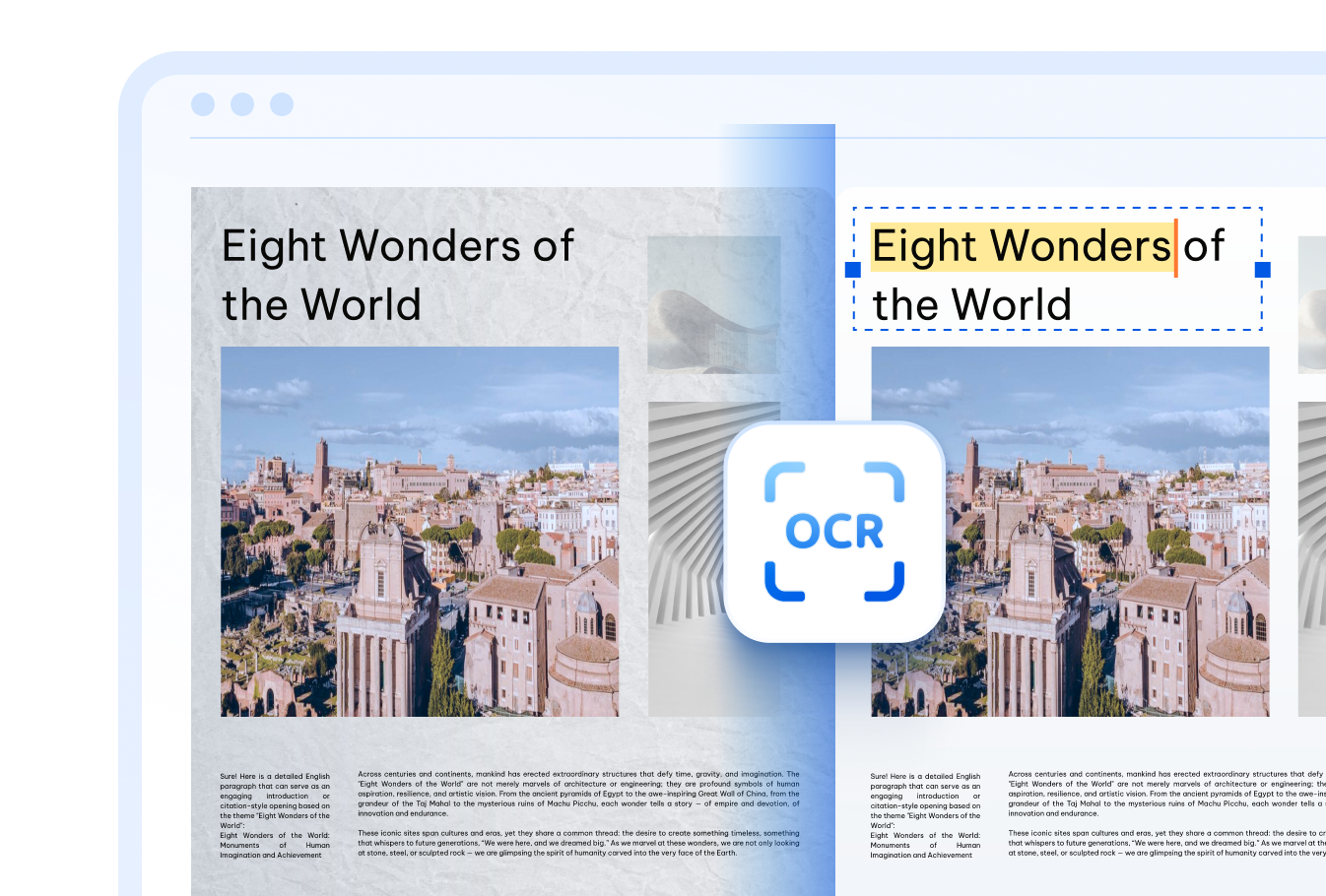
Once the Spanish text recognition online finishes, you translate inside the same window. No copying back and forth between apps. Worth more than it sounds when you're processing ten documents in an afternoon.
Photos taken sideways, under fluorescent store lighting, at 11pm with a dying phone battery — the engine straightens and brightens the image internally before reading. Recognition accuracy holds up. You don't need to fix the photo first.
Uploads go over an encrypted connection and are deleted from PDNob's servers shortly after. Nothing lingers that could later be exposed. Good to know if the document has your address on it.
Go beyond basic text extraction — PDNob PDF Editor lets you edit extracted content directly, annotate, sign, compress, and manage PDFs entirely offline. Built for professionals who need precision and speed in every document task.

Convert scanned documents, PDFs, and images into editable text with AI-powered OCR accuracy.
Upload your photo or scan to PDNob, choose Spanish, hit extract. The Spanish image to text converter reads the letters — accents and ñ included — and gives you clean, searchable text in seconds. No sign-up, no install.
Yeah. After recognition, one click translates the text into English inside the same window. No copy-pasting into a separate translator.
Printed text, very reliable. Neat handwriting, fine. Cursive or rushed handwriting — accuracy drops. Give it the sharpest, best-lit photo you can manage.
JPG, PNG, TIFF, BMP — all fine. Scanned PDFs too. A phone photo works as well as a flatbed scan, assuming it's in focus.
The cloud-based tool accepts files up to 15MB per upload. If you need to process larger batches or bigger scans, the PDNob desktop application removes that limit entirely.
On clean, well-lit images, PDNob correctly reads á, é, í, ó, ú, ñ, and the inverted marks ¿ and ¡. Results depend on image quality, font, and lighting — sharper source photos consistently produce cleaner output.
 PDNob Online
750,796,000 Users

PDF Leaders
Since 2007
10M+ Docs
Protected Daily
ISO
Certified Tools
Your Files
Never StoredEdit, merge, sign, and convert PDFs effortlessly.