

PDNob Online is currently available only on Windows and Mac desktop computers. Please switch to a desktop browser to use our features.
Founded in 2007, Tenorshare PDNob is trusted by millions to simplify work.
6,347,982 legal documents have been processed with our free legal OCR software.
Get PDNob Desktop, Your All-in-One PDF Solution!
Follow These 3 Steps to Extract Text from Legal Documents:
Upload a scanned contract, court filing, or legal PDF that needs to be digitized.
Choose the document language and click "Start OCR" to run legal document OCR on the file.
Download the result as a searchable, editable PDF. Direct in-browser copying of the extracted text isn't supported yet, so save the file to access the full content.
Pull a five-year-old photocopy out of a filing cabinet and the contrast is usually terrible. Off-the-shelf scanners misread clause wording on these all the time, and you don't always notice until something breaks downstream.
Briefs, statutes, and long clauses stack fine-print text shoulder to shoulder, often with footnotes running down the margins. Drop the scan quality a notch and you lose a footnote or a defined term that quietly changes the meaning of a whole section.
A contract can run numbered clauses, a fee table, an exhibit, and a signature page on the same document. Engines that expect a single column of plain text get confused here.
Re-keying legal text is tedious, and a mistyped number or date in a filed document can turn into a compliance problem later. One wrong decimal in a damages figure is the kind of thing that surfaces six months down the line.
An engine trained on legal layouts, not a generic OCR with a legal-themed landing page. The recognition model has been tuned for clause-numbered agreements, court filings, and multi-column briefs. Faded signatures, cramped footnotes, and photocopied exhibits come out as structured text you can actually search or file, usually in a few seconds.
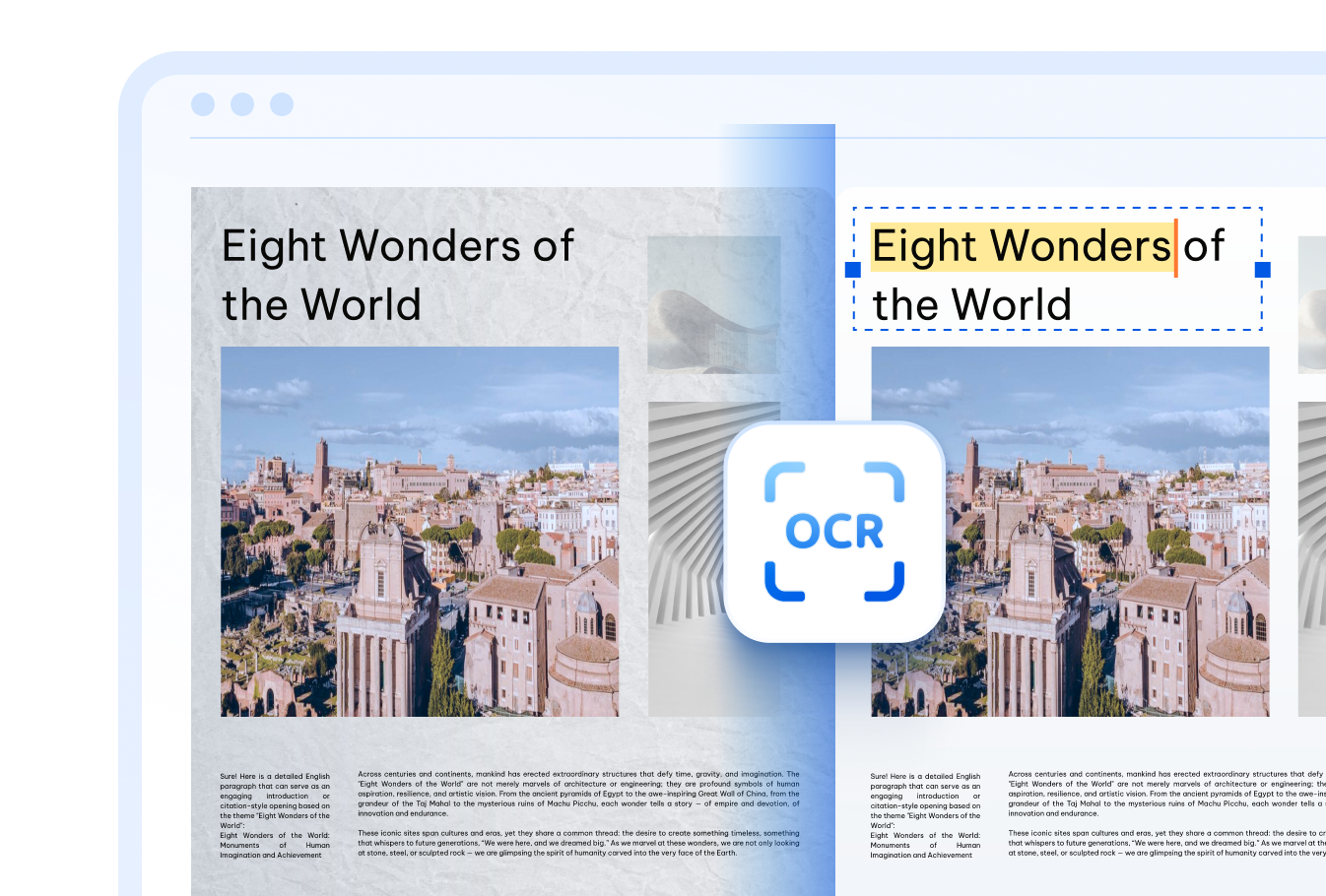
Searchable PDFs straight out. Once a contract or filing is processed, you download a searchable, indexable PDF. No extra conversion step before it slots into a case management system or document repository.
It copes with low-contrast scans. Old photocopies, fax-quality scans, aging archive documents are routine in legal work, and PDNob is tuned to pull readable text out of these weaker originals rather than returning half a page of garbage.
Encrypted in transit, deleted after processing. Files travel over an encrypted connection and are deleted from PDNob's servers shortly after. For documents that include client names, case details, or privileged terms, this is the default behavior, not an upsell.
PDNob's legal OCR converts scanned court filings, contracts, and case documents into structured fields — case headers, parties, dates, citations and key amounts captured in one pass.
The jurisdiction, court, and case identifiers that anchor every filing:
Every named party, counsel of record, and law firm in the matter:
The filing type and the metadata that shows up on the cover page:
Pulls every date that matters — hearings, deadlines, and statutory windows — into individual, searchable fields.
Detects every statute, regulation, and prior case cited within the document body.
Captures monetary figures and dispositions so financial and case-management fields stay accurate.
Convert scanned documents, PDFs, and images into editable text with AI-powered OCR accuracy.
Go beyond text extraction — PDNob PDF Editor lets you redline extracted contract text, add annotations, apply e-signatures, and manage case files entirely offline. Built for legal professionals who need precision on every clause.

Upload the scanned contract, filing, or case document to PDNob, pick the language, and hit "Start OCR." It reads the text and outputs a searchable, editable PDF in seconds. No account, no install.
Yes. PDNob's legal OCR processes multi-page contracts, exhibits, and attachments in one pass. You don't have to chop a 50-page agreement into separate files first.
Mostly yes. The recognition engine keeps the layout of numbered clauses, paragraphs, and tables intact where it can, so the result reads in the original document order instead of coming back as one flat block of text.
Not at the moment. There's no in-browser copy button on the OCR result. Download the processed file as a searchable, editable PDF and the full extracted text is available to copy from there.
Files are transferred over an encrypted connection and removed from PDNob's servers shortly after processing. The pipeline is built around handling client names, case details, and other privileged content responsibly.
Scanned PDFs plus JPG, PNG, TIFF, and BMP images — covering both flatbed scans and phone-camera photos of contracts or filings. Cloud-based uploads up to 15MB.
Edit, merge, sign, and convert PDFs effortlessly.
 PDNob Online
750,796,000 Users

PDF Leaders
Since 2007
10M+ Docs
Protected Daily
ISO
Certified Tools
Your Files
Never Stored