

PDNob Online is currently available only on Windows and Mac desktop computers. Please switch to a desktop browser to use our features.
Founded in 2007, Tenorshare PDNob is trusted by millions to simplify work.
7,215,384 Japanese images have been converted to text for free.
Get PDNob Desktop, Your All-in-One PDF Solution!
Follow These 3 Steps to OCR Japanese Text from Any Image:
Upload a photo, screenshot, or scanned file that contains Japanese text.
Set the recognition language to Japanese and click "OCR" to start Japanese OCR online free.
Save the Japanese text recognition result as a file.
A single line of Japanese can blend kanji, hiragana, and katakana together, so a scanner built for one alphabet often misreads the switch between scripts and garbles the result.
Novels, manga, and official notices are often printed in columns from top to bottom and right to left. This is a layout that current tools have difficulty in dealing with as they are mostly designed for horizontal Western text.
The small notes above kanji are quite helpful for pronunciation but, at the same time, their small size means that in a low-resolution photo, they can be lost or merged with the main characters.
No Japanese keyboard, and having to look up unfamiliar kanji by radical or stroke count to retype a document by hand, can turn a short page into a lengthy chore.
Rather than treating Japanese as a single script, the PDNob's engine is tuned to OCR Japanese text. Separate kanji, hiragana, and katakana are read correctly even when they sit side by side in the same sentence. Most of the time, faded receipts or glare on a photo or even a hurried phone snapshot doesn't really throw it off, and the output of Japanese optical character recognition comes back as text that you can copy, search, or edit right away.
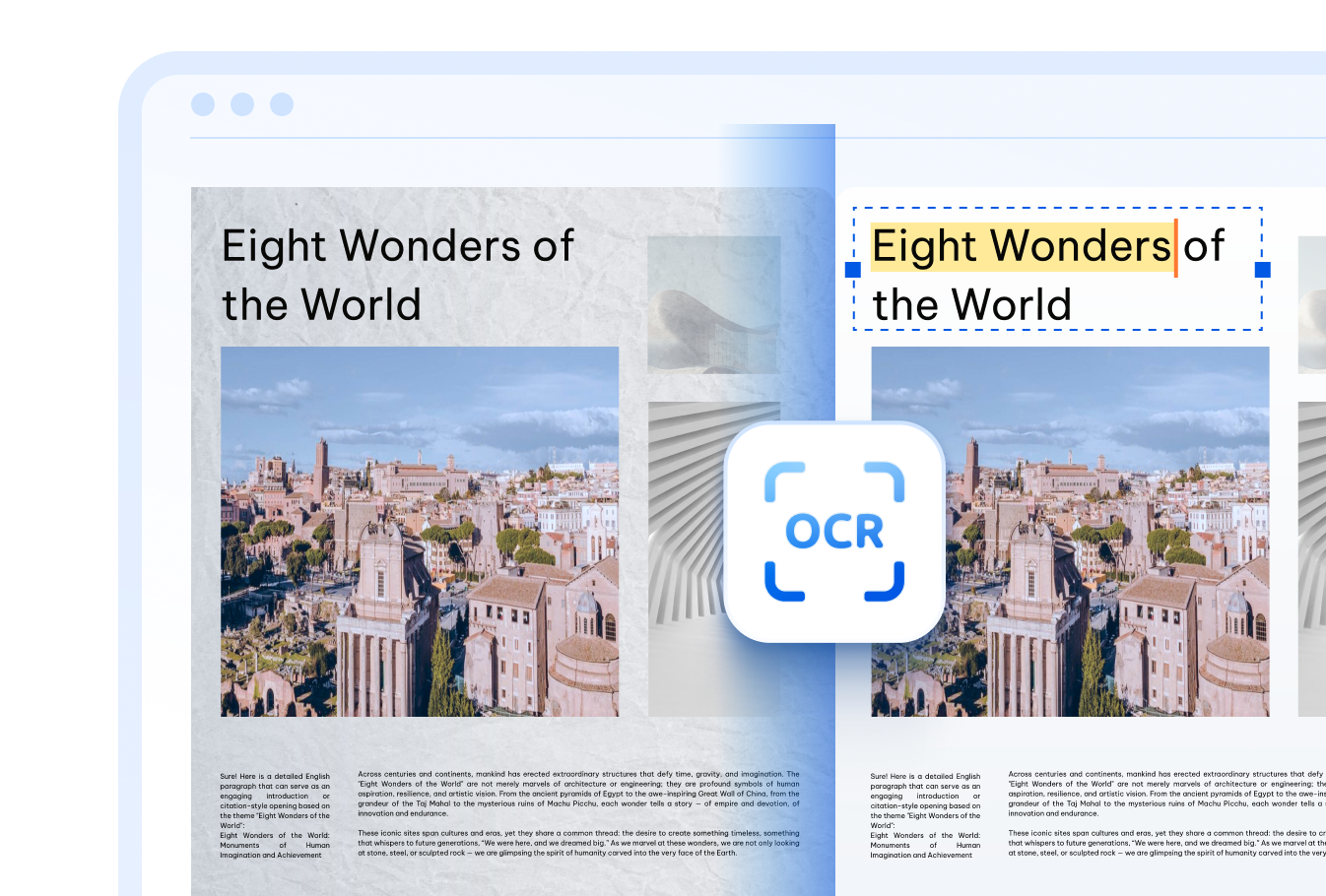
The instant the Japanese characters get recognized, the Japanese OCR software makes them searchable PDF right then and there — handy for menus, signage, contracts, or messages without switching to a separate translator.
Whether the source is a form printed horizontally or a page from a book or magazine laid out vertically, PDNob adapts to the direction of the text while implementing OCR Japanese pdf.
Data is transmitted via files that are moved over a TLS-encrypted connection; they are cleared from the servers of PDNob shortly after processing completes. Thus, scanned IDs and other private documents are not stored.
Convert scanned documents, PDFs, and images into editable text with AI-powered OCR accuracy.
Go beyond basic text extraction — PDNob PDF Editor lets you edit extracted content directly, annotate, sign, compress, and manage PDFs entirely offline. Built for professionals who need precision and speed in every document task.

Just upload your photo or scanned file to PDNob, select Japanese as the recognition language, and click the extract button. The engine will automatically break apart kanji, hiragana, and katakana and return editable text within seconds — without even making you sign up.
Yes. Whether a page is set horizontally or in the more traditional top-to-bottom, right-to-left column format — the kind you see in books, manga, and the like — PDNob detects the layout and reads it in the right order.
On a sharp, well-lit image, PDNob does a good job of picking up Japanese text from both images and print; very tiny or blurred text would benefit from a higher-resolution photo for the cleanest result.
It's trained just on Japanese script combinations, so a sentence that mixes all three writing systems will still be recognized character by character, instead of getting flattened into a single guess.
After the characters have been extracted, you can send the result to English translation with a single click, so you don't have to paste it into another translator app.
Files as large as 15MB can be uploaded using the online tool. In case of bigger batches of scans or photos, PDNob desktop application does away with this restriction.
Edit, merge, sign, and convert PDFs effortlessly.
 PDNob Online
750,796,000 Users

PDF Leaders
Since 2007
10M+ Docs
Protected Daily
ISO
Certified Tools
Your Files
Never Stored