

PDNob Online is currently available only on Windows and Mac desktop computers. Please switch to a desktop browser to use our features.
Founded in 2007, Tenorshare PDNob is trusted by millions to simplify work.
4,127,395 invoices and receipts have been processed with invoice OCR.
Get PDNob Desktop, Your All-in-One PDF Solution!
Follow These 3 Steps to Read Invoice Data from Any Scan:
Upload a scanned PDF or photo of an invoice, receipt, or shipping document to our invoice OCR tool.
Pick the recognition language and click "OCR PDF" to start invoice OCR processing.
Download the recognized invoice OCR extraction as a searchable PDF or copy fields straight into a spreadsheet.
Every vendor ships invoices in a different layout, so a rigid template-driven OCR engine keeps missing line items the moment the format shifts by even one column.
A receipt stuffed in a wallet, a thermal printout under fluorescent light, or a phone photo taken at an angle can easily defeat a generic ocr invoice capture workflow.
Invoices stack subtotals, tax lines, discounts, and multi-currency totals into dense tables, and line-by-line OCR collapses when totals have to align across columns.
Stamps, signatures, and handwritten notes layered on top of printed invoice numbers break single-pass OCR, so separating the printed text from the marks is half the battle.
PDNob's invoice OCR software runs on the ABBYY recognition engine, which is specifically tuned for invoices, receipts, and structured business paperwork. Whether the source is a flatbed scan, a forwarded PDF, or a smartphone snapshot, invoice scanning OCR technology pulls vendor names, invoice numbers, dates, line items, and totals as editable fields — ready to drop straight into Excel or your accounting stack.
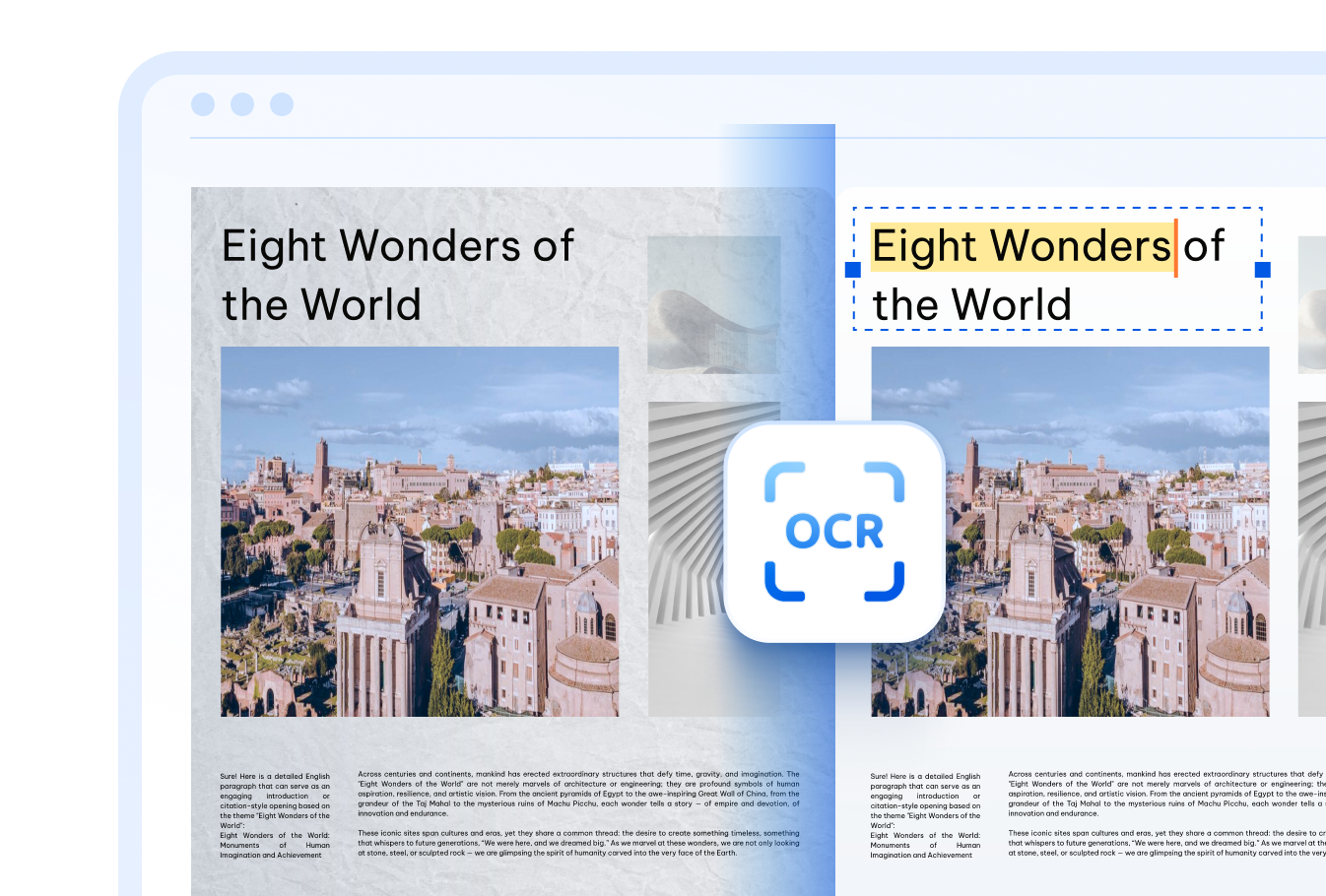

After ocr invoice processing wraps, PDNob hands back a searchable PDF that keeps the original invoice layout intact, so any field can be highlighted, copied, or searched later — handy for audits, vendor checks, and month-end reconciliation.
A snap taken under harsh office lighting or a receipt creased down the middle can still throw off generic OCR. PDNob's engine handles small fonts, skewed angles, and faint thermal prints so ocr invoice extraction keeps working where off-the-shelf scanners stall.
Every invoice you upload travels over an encrypted channel and is removed from our servers shortly after ocr invoice capture wraps, so documents are never stored long-term and never shared with third parties.
PDNob's invoice OCR recognizes structured fields across the whole document clearly with intact layout.
Extracts supplier details from invoices, including names, addresses, and tax information.
Document identifiers and key dates that drive every AP workflow downstream.
Each product row comes through as a structured record — items, quantities and prices when the source invoice carries them.
Multi-rate VAT, GST, and sales-tax structures split cleanly across rows — ideal for region-specific filing.
Every figure needed for reconciliation, captured as its own field.
Classification and quality signals that route the document automatically — the fields your downstream rules actually key on.
Convert scanned documents, PDFs, and images into editable text with AI-powered OCR accuracy.
Go beyond basic text extraction — PDNob PDF Editor lets you edit extracted content directly, annotate, sign, compress, and manage PDFs entirely offline. Built for professionals who need precision and speed in every document task.

Edit, merge, sign, and convert PDFs effortlessly.
Upload your scanned invoice or receipt to the invoice OCR tool and click "OCR PDF". The ABBYY-powered engine reads the document, identifies invoice fields like vendor, date, line items, and total, and hands back an editable, searchable PDF plus copyable text.
Yes. PDNob's invoice OCR software is template-agnostic, so it recognizes fields across vendor layouts — net-30 invoices, utility bills, shipping manifests, and itemized receipts all flow through the same pipeline without custom template setup.
The engine reads printed invoice numbers and amounts precisely, and treats stamped dates, signatures, and handwritten notes as separate layers in the output — so they won't pollute the recognized totals. Final accuracy depends on how clearly the marks were applied.
PDNob accepts JPG, JPEG, PNG, TIFF, and BMP images, plus scanned PDF invoices forwarded by email. Phone-camera snapshots work as well as flatbed scans, as long as the invoice is fully visible and not cropped.
Yes. After the recognition job finishes, the recognized fields can be exported as a structured CSV or copied directly into an Excel template — useful when you want to bulk-import invoice OCR data into a bookkeeping workflow.
Yes. The output separates header fields — vendor, invoice number, issue date, due date, subtotal, tax, and grand total — from line items, so each value can be validated independently before the invoice is archived or paid.
 PDNob Online
750,796,000 Users

PDF Leaders
Since 2007
10M+ Docs
Protected Daily
ISO
Certified Tools
Your Files
Never Stored