

PDNob Online is currently available only on Windows and Mac desktop computers. Please switch to a desktop browser to use our features.
Founded in 2007, Tenorshare PDNob is trusted by millions to simplify work.
7,942,183 Chinese images have been converted to text for free.
Get PDNob Desktop, Your All-in-One PDF Solution!
Follow These 3 Steps to Read Chinese Text from Any Image:
Upload a photo, screenshot, or scanned file that contains Chinese text.
Set the recognition language to Chinese and click "Start OCR" to begin extraction.
Copy the recognized Chinese text, or translate it into English with one click.
A phone shot of a menu or shop sign rarely comes out perfectly straight — glare, tilt, and shadows are the norm rather than the exception, and that inconsistency trips up basic image-to-text tools built mainly for flat, scanned pages.
Mainland receipts, Hong Kong contracts, and Taiwanese forms don't share the same character set, and a single document can blend Simplified and Traditional Hanzi with Pinyin annotations — a combination many OCR engines aren't trained to tell apart.
Official forms, customs declarations, and legal notices often pack a large amount of text onto a single page. When the print is small and the scan resolution is low, whole lines of characters can be lost or garbled entirely.
Without a Chinese input method already configured, typing out a document character by character is slow and easy to get wrong, turning what should be a two-minute task into a frustrating half hour.
PDNob's recognition engine has been trained on both Simplified and Traditional Chinese, so it holds up whether you're scanning a business license from Shanghai or a handwritten note from Taipei. Low-contrast or pixelated Hanzi characters, chinese image to text conversions that once required manual retyping, now come out as clean, searchable text within seconds.
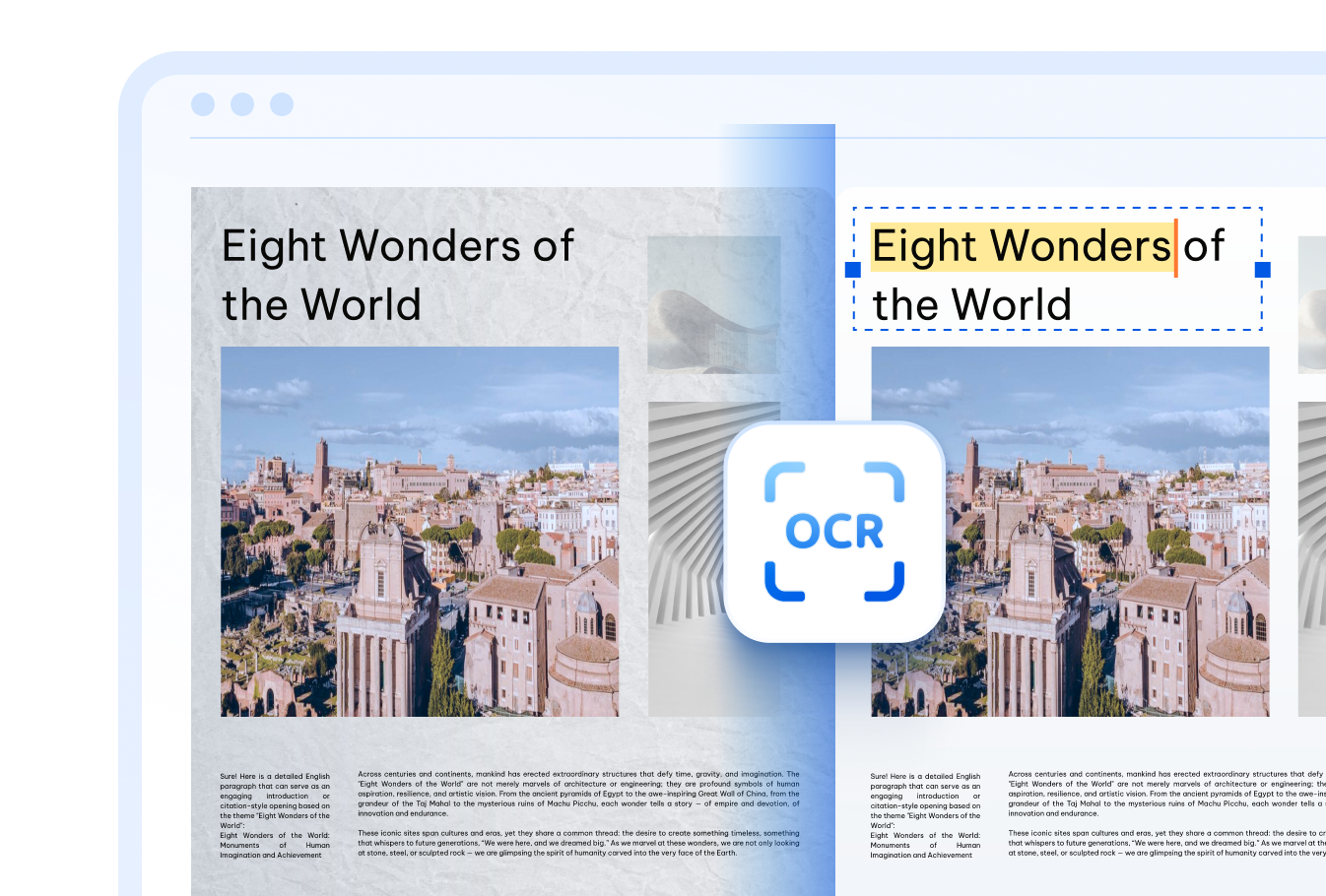
Once a document has been through our chinese character identifier, you can easily have it as an editable and searchable PDF — useful for reading contracts, menus, or messages without switching between separate apps.
Photos taken in a hurry are rarely perfect — shaky hands, dim lighting, awkward angles. PDNob's chinese word identifier still manages to pull legible text out of these imperfect shots, so retyping isn't necessary.
Every file travels over an encrypted connection and is wiped from our servers shortly after processing finishes, so nothing you upload sits around waiting to be seen by anyone else.
Convert scanned documents, PDFs, and images into editable text with AI-powered OCR accuracy.
Go beyond basic text extraction — PDNob PDF Editor lets you edit extracted content directly, annotate, sign, compress, and manage PDFs entirely offline. Built for professionals who need precision and speed in every document task.

Upload your photo or scanned file to PDNob, set the recognition language to Chinese, and click the extract button. The AI-OCR engine reads Simplified or Traditional Hanzi and returns editable, searchable text within moments — no account or software install needed.
The cloud-based tool accepts files up to 15MB per upload. For larger batches or bigger scans, the PDNob desktop application removes that limit entirely.
PDNob handles printed Hanzi reliably and can recognize clear, neatly written handwriting reasonably well. Cursive or heavily stylized handwriting may lower accuracy, so a well-lit, straight-on photo tends to give the best results.
PDNob accepts common formats such as JPG, PNG, TIFF, and BMP, plus scanned PDF files. A photo taken directly on a phone camera works about as well as a flatbed scan.
On clean, well-lit images, PDNob's Chinese OCR reaches high accuracy for both Simplified and Traditional Hanzi. Results depend on image quality, font style, and lighting — sharper source photos consistently produce cleaner output.
Edit, merge, sign, and convert PDFs effortlessly.
 PDNob Online
750,796,000 Users

PDF Leaders
Since 2007
10M+ Docs
Protected Daily
ISO
Certified Tools
Your Files
Never Stored