

PDNob Online is currently available only on Windows and Mac desktop computers. Please switch to a desktop browser to use our features.
Founded in 2007, Tenorshare PDNob is trusted by millions to simplify work.
8,215,473 newspaper pages and articles have been processed with ocr newspaper.
Get PDNob Desktop, Your All-in-One PDF Solution!
Follow These 3 Steps to Read Old News Articles and Archives:
Drag a scanned newspaper page, a forwarded PDF of an old issue, or a clipping photo into the tool. The same Ocr newspaper pdf pipeline handles JPG, JPEG, PNG, TIFF, and BMP.
Pick the recognition language (auto-detect for mixed-script archives works), choose the output format, and click "OCR PDF" to start the run.
Download the result as a searchable PDF, or copy the article body straight into your archive, citation manager, or spreadsheet.
Newsprint yellows and the ink fades within a few decades, so the foreground-to-background contrast collapses and a generic newspaper extract engine reads the article body as a wash of low-contrast gray instead of crisp characters.
A typical front page stacks five or six narrow columns with headlines that span two or three of them. A linear OCR pass reads across the gutter and merges two unrelated sentences, which is one of the main ocr challenges black historical newspapers and genealogy projects keep running into.
Pre-1950s papers set headlines in woodblock and metal type with ligatures, swashes, and condensed caps. A character model trained on modern sans-serif fonts keeps misreading "ſ" as "f" and turning "ſtate" into "ftate", which throws every downstream search off.
Bound issues carry a deep gutter shadow, microfilm scans come out blurry, and brittle pages tear halfway through a scan. The pre-processing step has to flatten the page, recover the gutter, and reconstruct the missing margin before the recognition pass can run cleanly.
PDNob's newspaper ocr software runs on the ABBYY recognition engine, tuned for historical and modern print alike. Whether the source is a flatbed scan of a 1923 broadsheet, a forwarded PDF of last week's issue, or a phone snap of a clipping pinned to a fridge, the engine returns the headline, byline, article body, and page metadata as structured text. The result feeds straight into a free archive, a citation manager, or a research database — without manual retyping.
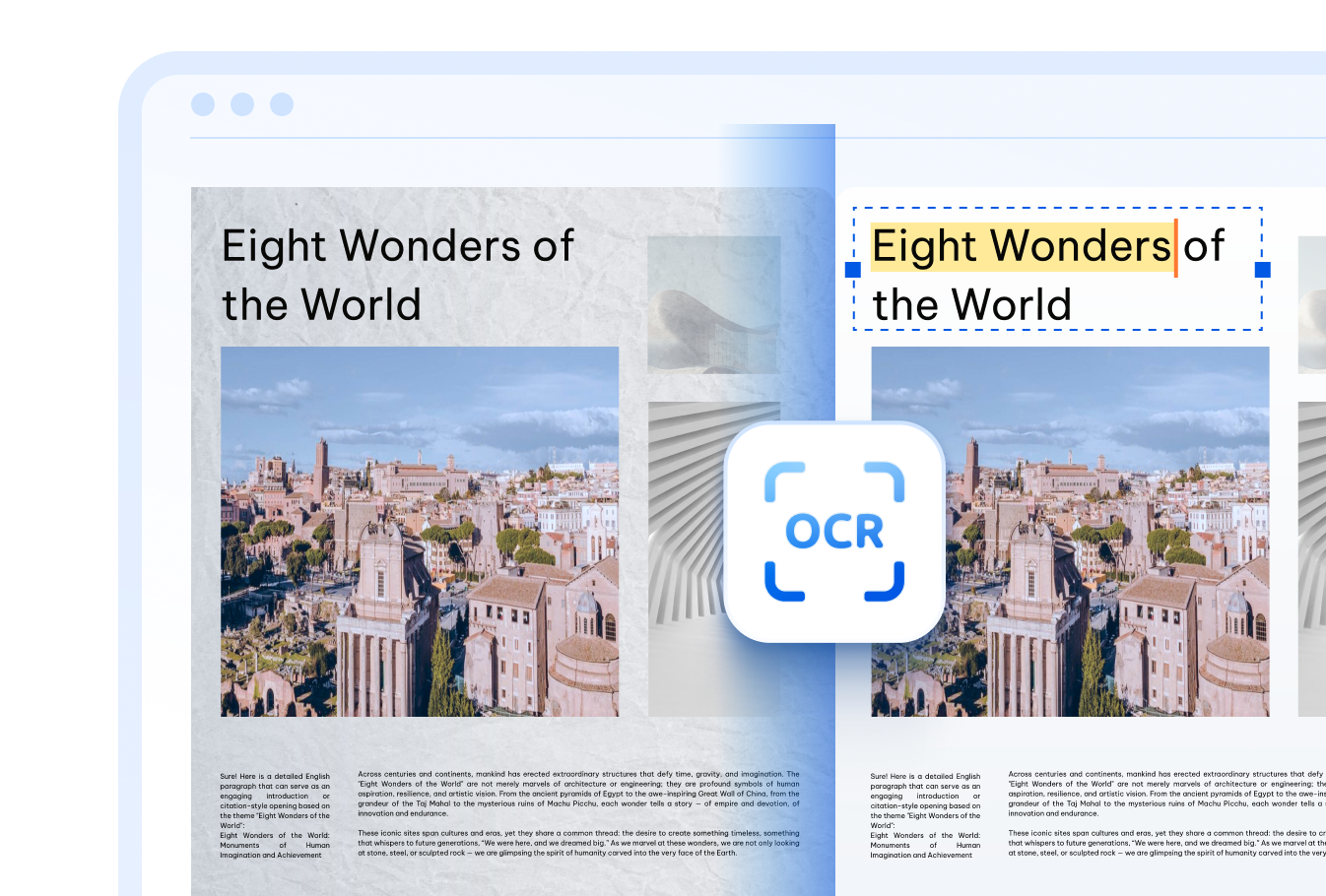
After recognition wraps, PDNob hands back a searchable PDF that keeps the original page layout intact, so any headline, byline, or column can be highlighted, copied, or searched later, which is useful for citation pull, fact-check, and long-tail archive navigation.
A snap of a 1950s clipping under desk light or a low-DPI microfilm scan can still throw off generic OCR. PDNob's engine handles condensed metal type, ligatures, and faint halftone dots so the run keeps producing clean text where off-the-shelf readers stall.
Every page you upload travels over an encrypted channel and is removed from our servers shortly after recognition wraps, so historical scans, embargoed clippings, and personal archives are never stored long-term and never shared with third parties.
The recognition engine keeps the column boundaries and image placement intact so the output mirrors the print edition.
The display text that drives every archive search result, front-page index, and clipping preview.
The text body and the metadata that names who wrote it and when it ran.
The identifiers that route a clipping to the right issue, page, and column once it lands in your newspaper clipping to text archive.
The text that sits next to a photograph, with the credit line that links back to the source.
The engine flags ad zones so downstream search can hide them or index them separately from editorial copy.
Per-page quality signals and layout metadata that route the page automatically and let a downstream rule flag a borderline scan for human review.
Go beyond basic text extraction — PDNob PDF Editor lets you edit extracted content directly, annotate, sign, compress, and manage PDFs entirely offline. Built for professionals who need precision and speed in every document task.

You can run ocr newspaper in the browser for free, with no subscription required. The free tier accepts a scanned newspaper page, The free tier accepts a scanned newspaper page, an old archive PDF, or a clipping photo, and returns a searchable PDF plus copyable text for headline, byline, and article body. Files are removed from the server shortly after the run finishes, so the free workflow is the same one paid genealogy and newsroom projects use to seed their archive.
The standard pipeline is: scan the page at 300 DPI or higher, run the OCR pass with auto-language detection, export the result as a searchable PDF plus per-article JSON, and route the output into a digital archive. PDNob's pipeline packages all four steps in a single run, so a stack of bound issues from the 1890s lands in the archive as a per-page PDF and a per-article JSON record in one go, instead of needing a separate OCR pass and a separate metadata step.
Yes, several readers will work on poor-quality scans, but most modern engines collapse once the source is a low-DPI microfilm or a 1900s broadsheet. PDNob's pipeline pairs the ABBYY recognition engine with a pre-processing pass that denoises, de-skews, and lifts the foreground/background contrast on faded newsprint, so a 1923 archive scan that fails in a free phone app tends to come back as readable text after the pre-processing step runs. The trick is to upload at 300 DPI or higher and let the engine pick the model per column.
An AI-Powered Digital Archive for Newspapers & Publications layers three things: a per-page OCR engine that returns headline, byline, article body, and image caption; a classification step that splits editorial from display ads and public notices; and a per-field confidence score that lets a downstream rule route borderline pages to a human reviewer instead of polluting the search index. PDNob's recognition pipeline packages all three in a single run, so a backfill project can ingest a hundred issues per hour and still surface a low-confidence page for review.
Yes. After the recognition job finishes, the recognized text from a clipping can be exported as a structured CSV, copied into an Excel or Google Sheets cell, or saved as a plain-text file alongside the original clipping image. The same export step that supports newspaper clipping to text also handles per-article JSON output, so a research database can index the headline, byline, and article body as separate fields rather than as one big text blob.
A newspaper extract run separates the page into per-article records, with headline, byline, publication date, and article body returned as independent fields. The output is designed so each article can be indexed, cited, or quoted without dragging in the surrounding column text, which matters when the source is a 1920s front page with six overlapping stories and you only need one of them.
 PDNob Online
750,796,000 Users

PDF Leaders
Since 2007
10M+ Docs
Protected Daily
ISO
Certified Tools
Your Files
Never Stored